
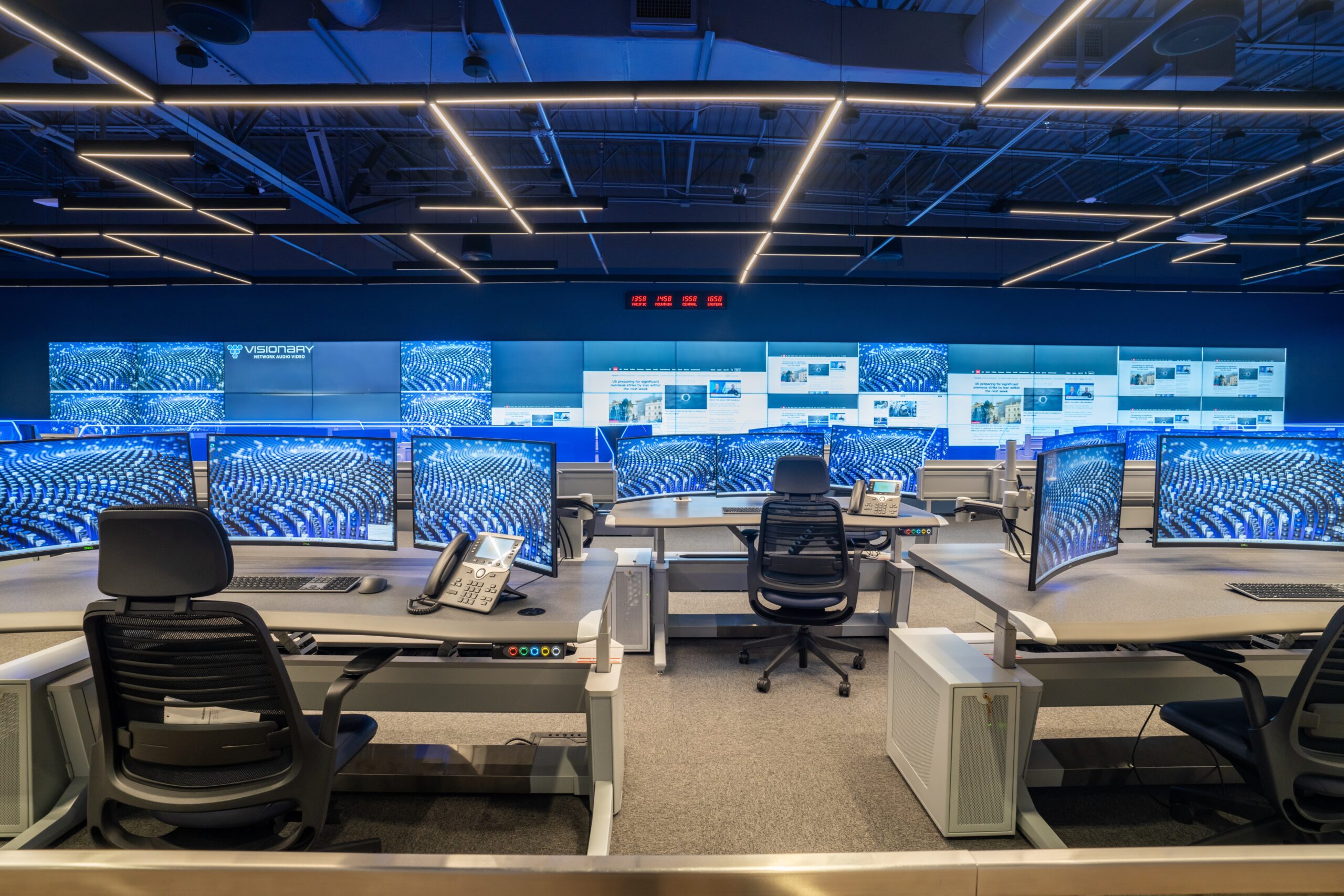
GSOC stands for Global Security Operations Center — a centralized command facility that collects, analyzes, and acts on security intelligence across multiple sites, regions, or business lines. A GSOC provides 24/7 situational awareness and coordinated response for physical and operational threats; it can also integrate digital signals and business continuity functions
Why it matters: Organizations operating at scale (multi-site facilities, global supply chains, high-value assets, or widely distributed personnel) need consistent monitoring, faster incident response, and standardized procedures — all core GSOC functions that reduce risk and improve operational continuity
Plain-English definition: A GSOC is the “nerve center” for an enterprise security program: people, processes, and technology combined to detect incidents early, coordinate response, and keep leadership informed.
What a GSOC Does
Monitoring & Triage: Aggregates alerts from CCTV, access control, alarm systems, incident reports, open-source intelligence, and third-party feeds; analysts triage incoming data to identify real incidents versus noise.
Incident Management: Coordinates initial response, documents the incident lifecycle, escalates to on-site teams or law enforcement, and ensures post-incident actions (investigation, evidence preservation, lessons learned).
Dispatch Coordination: Sends guards, technicians, or emergency services as needed and maintains the communications loop between field units and command staff.
Vendor & Partner Coordination: Acts as the central contact for contracted security vendors, technology providers, and external analysts during an incident to speed remediation.
Reporting & KPIs: Produces dashboards and post-incident reports measuring SLAs, response times, false alarm rates, and trend analysis for leadership and compliance.
Core Components
People
24/7 trained analysts and supervisors (tiered roles: first responders, investigators, shift leads).
Liaison/officer roles for legal, HR, facilities, and executive communications.
Process
Standard operating procedures, playbooks, escalation matrices, and incident classification schemes.
Regular exercises, after-action reviews, and continuous improvement loops.
Technology
Video management systems (VMS), access control integrations, incident ticketing, analytics/AI for anomaly detection, and a unified console.
Metrics
Typical GSOC metrics: time-to-detect, time-to-dispatch, time-to-resolve, false alarm rate, and SLA compliance. These feed executive-level dashboards and drive resource decisions.
GSOC vs SOC vs NOC
| Function | GSOC (Global Security Ops) | SOC (Security Ops Center) | NOC (Network Ops Center) |
| Primary focus | Enterprise-wide physical & operational security; global coordination | Cybersecurity: detection/response to cyber threats | Network performance, uptime, and IT infrastructure health |
| Data sources | CCTV, access control, guards, travel, logistics, OSINT | Logs, IDS/IPS, endpoints, SIEM | Network devices, bandwidth, routers, servers |
| Typical staffing | Security analysts, regional liaisons, crisis leads | Incident responders, threat analysts | Network engineers, sysadmins |
| Outcome | Faster cross-site response and continuity | Reduced cyber risk and breach containment | High availability and service performance |
(The table highlights complementary roles — large orgs often need more than one of these functions.)
Benefits (ROI)
Faster, consistent responses: Centralized monitoring shortens detection-to-action windows across all sites.
Reduced incident costs: Quicker containment lowers asset damage, liability, and business interruption losses.
Guard substitution & efficiency: GSOCs can triage and remotely verify alarms, reducing unnecessary guard dispatch and lowering guard spend.
Better visibility for leadership: Unified dashboards and trend reporting improve risk decision-making and budgeting.
Scalability: One GSOC can standardize security across acquisitions, new sites, or global operations, avoiding duplicated practices.
When You Need a GSOC
You operate multiple sites or countries and need consistent security practices.
You manage high-value cargo, critical infrastructure, or complex supply chains where localized failure cascades.
You require 24/7 remote monitoring with centralized escalation and coordination.
You want to consolidate vendor management and reduce redundant on-site resources.
Recommended Actions for Organizations
Assess scale & risk: Map locations, assets, and the cost of downtime to decide if a GSOC (build vs buy) makes financial sense.
Define scope: Choose whether GSOC will cover physical security only, or include cyber/IT inputs and business continuity.
Start with integrations: Prioritize VMS, access control, alarms, and ticketing integrations for immediate situational value.
Create playbooks: Build incident playbooks for high-probability scenarios (theft, active threats, supply disruption).
Staffing model: Consider a hybrid model—regional field teams plus a centralized GSOC—or partner with a managed GSOC provider.
Measure outcomes: Track SLAs and cost savings (reduced false alarms, fewer unnecessary dispatches, quicker recovery).
Key Takeaways
A GSOC centralizes security monitoring and response across multiple sites to improve detection, coordination, and continuity.
Core pillars are people, process, and technology; success requires integrations and clear playbooks.
GSOCs reduce incident impact, improve reporting, and can lower on-site guard costs through smarter verification and dispatch.
Consider a phased approach: assess risk, integrate critical systems, adopt playbooks, and measure KPIs to prove ROI.
Next Steps for Security Leaders
If you need to evaluate whether a GSOC fits your enterprise risk profile—or want support building the business case, operating model, or project plan—engaging experienced GSOC advisors can accelerate decision-making and reduce execution risk.
At MTC Group, we design and build state-of-the-art GSOCs or deliver GSOC-as-a-Service for organizations that need speed, scalability, or lower upfront capital. We support the full lifecycle, including ROI assessment, pilot programs, technology selection, and project management—helping you move confidently from assessment to implementation.
