

Let's be honest: most executives see security as a necessary evil. It's the line item that gets begrudgingly approved every year, the cost center that never seems to shrink, and the department that only gets attention when something goes wrong.
But here's the thing: you're thinking about security all wrong.
What if your security spend wasn't just protecting assets: what if it was actually generating profit? Not in some vague "we avoided a breach" way, but in real, measurable dollars that show up on your balance sheet every quarter.
That's not a pipe dream. It's exactly what we help logistics and supply chain leaders achieve at MTC Group. And we're going to show you how.
The $4.88 Million Problem
The average data breach in 2024 cost companies $4.88 million. But here's what keeps supply chain executives up at night: targeted supply chain attacks regularly exceed $8 million in total damage when you factor in operational disruption, cargo theft, and third-party vendor compromises.
Traditional physical security consulting approaches this the wrong way. They add more guards, more cameras, more locks: which means more costs. You're stacking expenses on top of expenses, hoping that sheer volume will protect you.

Meanwhile, your CFO is asking uncomfortable questions about security ROI, and you're left trying to explain why you can't quantify the value of "nothing bad happening."
The Shift: From Cost Center to Profit Center
Here's where things get interesting. When we talk about supply chain security ROI, we're not just measuring what you avoided: we're measuring what you gained.
The formula that actually matters is Return on Security Investment (ROSI):
ROSI = (Risk Exposure × Risk Mitigation Percentage – Cost of Solution) ÷ Cost of Solution
Let's make this real. Say your organization faces $3 million in annual risk exposure from supply chain vulnerabilities: cargo theft, facility breaches, operational disruptions. You implement a comprehensive physical security assessment and integrated monitoring system that costs $200,000 annually and reduces your risk by 75%.
Your ROSI? ($3,000,000 × 0.75 – $200,000) ÷ $200,000 = 10.25
That's a 1,025% return on investment. Not hypothetical. Not aspirational. Actual, calculable value.
Where the Real Money Lives
The biggest opportunities for supply chain security ROI cluster in three areas:
1. Eliminating or Dramatically Reducing Physical Guard Spend
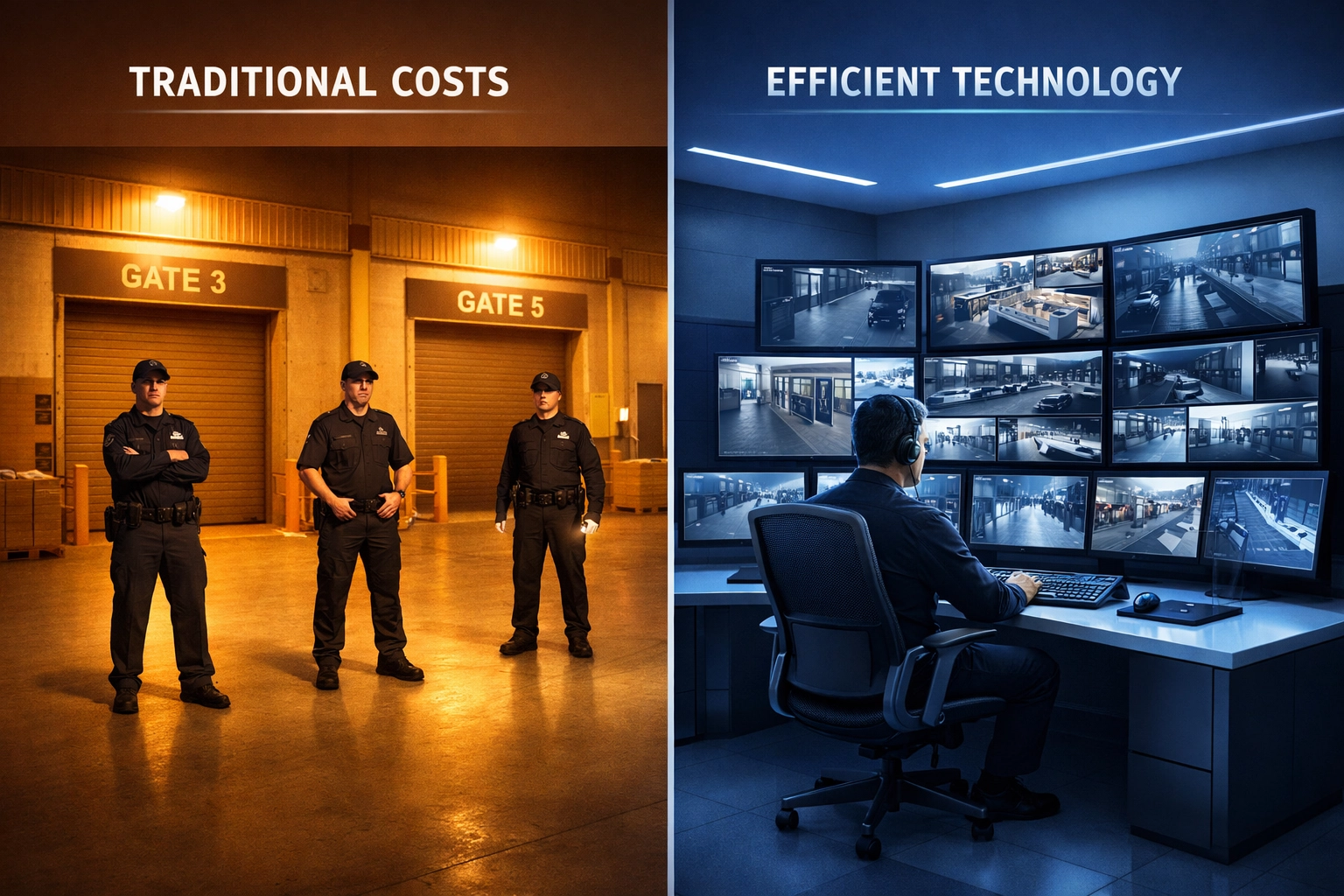
This is where most organizations are hemorrhaging money. We've helped clients achieve 50%+ reductions in physical guard costs by transitioning to remote video monitoring and 24/7 security monitoring systems. Instead of paying $30-50 per hour for on-site guards who can only watch one location at a time, you're investing in integrated systems that monitor multiple sites simultaneously at a fraction of the cost.
One distribution center client was spending $380,000 annually on overnight security guards. We implemented a remote monitoring solution that cost $140,000 per year: saving them $240,000 annually while actually improving response times and incident documentation.
2. Preventing Cargo Theft and Supply Chain Disruption
Cargo theft costs the logistics industry billions annually. But here's what executives miss: it's not just the stolen goods. It's the supply chain disruption, the insurance premiums, the customer relationships, and the operational chaos.
A single cargo theft incident can cascade into six-figure losses when you account for:
- Replacement product costs
- Expedited shipping to fulfill delayed orders
- Customer contract penalties
- Insurance deductible payments
- Increased future premiums
- Staff time managing the crisis
Strategic cargo theft prevention through access control integration and physical security assessments typically pays for itself after preventing just one or two significant incidents. We've helped clients reduce cargo theft incidents by 80%+ within the first year of implementation.
3. Turning Security into Operational Intelligence
This is where security stops being a cost and starts generating value. Modern security systems integration doesn't just protect: it provides operational intelligence that improves your entire supply chain.
The data from your security systems can help you:
- Optimize staff scheduling based on actual facility traffic patterns
- Identify bottlenecks in loading and unloading operations
- Reduce insurance premiums through documented security improvements
- Streamline vendor access and reduce administrative overhead
- Generate compliance documentation automatically
One client discovered through their integrated security data that unauthorized after-hours facility access (which they thought was a security issue) was actually revealing a major workflow inefficiency. Fixing that workflow saved them $180,000 annually in overtime costs: value they never would have captured with traditional security approaches.

The MTC Approach: Making Security Self-Funding
Here's how we think differently about security risk management consulting: we design systems that pay for themselves.
Our physical security assessments start by identifying your actual risk exposure across your supply chain: not generic threats, but the specific vulnerabilities that could cost you money. Then we prioritize solutions based on financial impact, not fear.
For most logistics operations, this means:
Step 1: Calculate your current total cost of security (guards, systems, insurance, losses from theft/breach)
Step 2: Identify your annual risk exposure: what could realistically happen and what would it cost?
Step 3: Design integrated solutions that reduce both ongoing costs AND risk exposure
Step 4: Implement in phases, showing ROI at each stage
We've had clients achieve payback periods of less than 18 months on comprehensive security overhauls. More importantly, they're generating positive ROI every year after that initial payback.

The Numbers That Matter to Your CFO
When you're presenting supply chain security ROI to financial decision-makers, they want three things:
Payback Period: How fast does this investment return the initial cost? Formula: Initial Investment ÷ Annual Savings. Anything under 3 years gets attention. Under 2 years gets approved.
Annual Recurring Savings: What's the ongoing financial benefit? This should include both cost reductions (eliminated guard spend) and avoided losses (prevented theft/breaches).
Operational Efficiency Gains: What soft costs improve? Faster vendor onboarding, reduced administrative burden, better incident response, enhanced compliance documentation.
Organizations that track these metrics consistently see the best results. One supply chain enhancement project we completed showed:
- 55% reduction in security labor costs
- $420,000 in prevented cargo theft (first year)
- 23% improvement in incident response time
- 40 hours per month saved in security administration
Total first-year ROI: 340%.
Getting Started: Your Next Steps
Transforming your security spend into measurable ROI doesn't require a complete overhaul overnight. Start with these practical steps:
Audit your current spending. Most organizations don't actually know their total security cost when you factor in guards, systems, insurance, administrative time, and losses.
Calculate your risk exposure. What are you actually protecting, and what would it cost if something went wrong? Be specific and realistic.
Prioritize high-impact, low-friction improvements. You don't need to rip and replace everything. Start with areas where technology can quickly replace expensive manual processes.
Measure and document everything. The only way to prove ROI is through data. Track costs before and after, document prevented incidents, quantify operational improvements.
The Bottom Line
Supply chain security doesn't have to be a cost center. With the right approach to physical security consulting and security systems integration, it becomes a profit-generating asset that pays for itself while protecting your operations.
The question isn't whether you can afford to invest in better security. The question is whether you can afford not to: especially when the investment generates measurable returns that compound year over year.
Ready to see what's possible for your operation? Let's talk about turning your security spend into a competitive advantage.
